

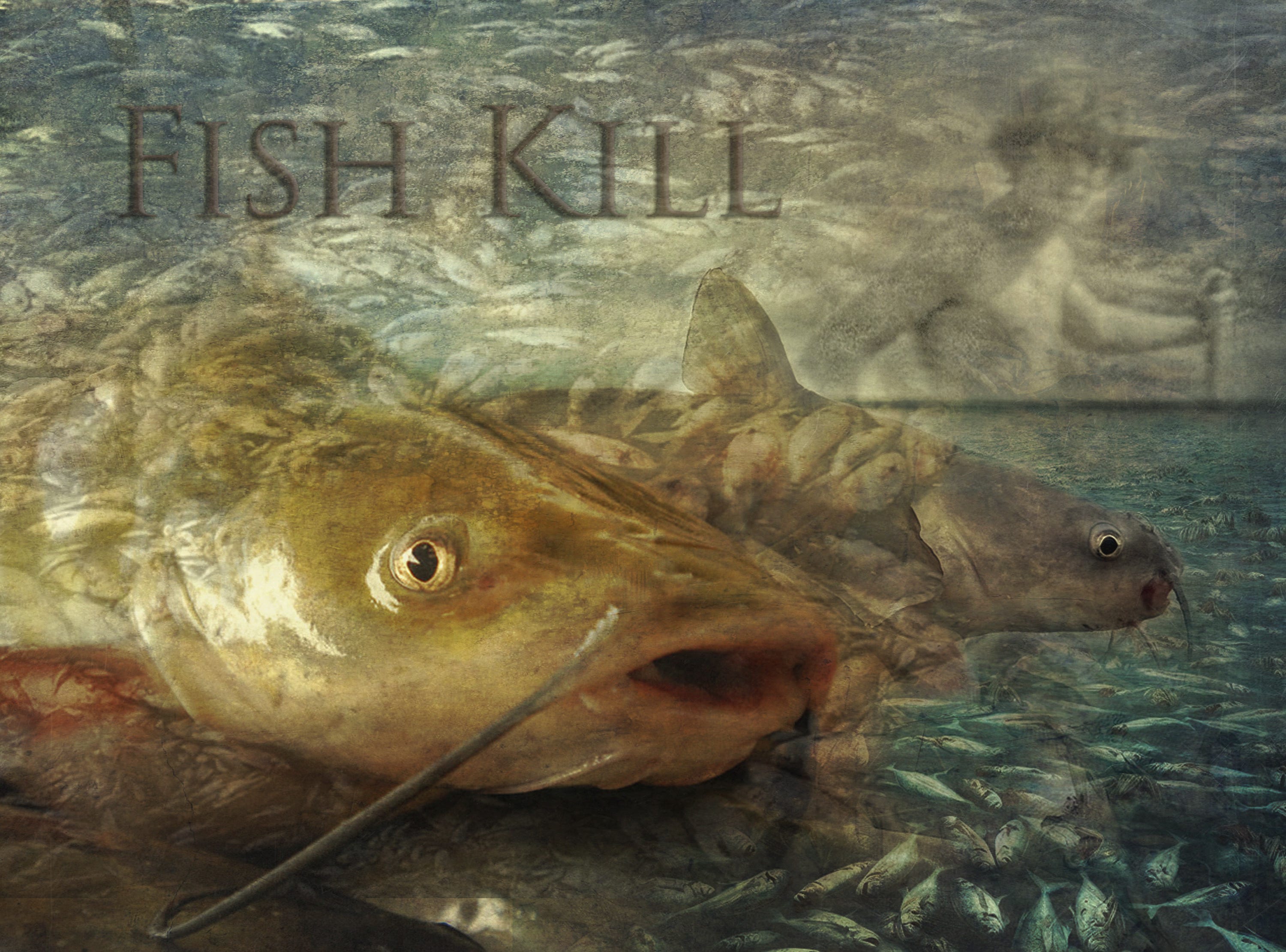
A fish kill was the final tragedy in a fast-moving chain of events that had already begun to spin wildly out of control, before anyone noticed or could get ahead of it.
Invisible. Subsurface. Deadly. Only its fatal results were apparent from a pond’s muddy shore. Its causes were much harder to spot. They had to be watched for carefully, pre-empted, constantly.
Bloated, dead catfish baking in the sun. Rotting. Blowing up.
Greedy, fat flies, noisy and swarming; thick clouds of them sawing through the oppressive swelter, cloying, sweet air. Feeding. Mating. Impregnating. Crawling and buzzing. Gluttons commuting and excavating. Worming their way in and out of rotting flesh.
Hornets and yellow jackets, and starving, stray dogs.
A stench, hard to describe and harder yet to endure.
There will never be enough bath water in the world, never enough bars of perfumed soap. Never enough Tide or Clorox bleach to mix with your clothes in the wash.
Economic and humanitarian considerations aside, just one afternoon gathering a mass of rotting fish, picking baskets full of maggot-infested ghost bodies from the parched banks of a dying pond before dousing them with diesel, before burning them into a pile of greasy ash in a ditch, or swimming among hundreds of their bloated bodies bobbing on the putrid water’s surface, gagging and retching all the way out to pick them from the plugged drain screen that simply could not drain, unable to siphon off the sweltering, foul, surface water that kept rising higher and higher as more and more of those floating dead were sucked into the snoring grid while thousands of gallons of dense, chilled, well water tumbled in at the other end of the pond.
Just one horrifying afternoon of such insanity is enough to inspire a new and profound reverence …for life, and death, and a rabid, hyper-vigilant devotion to each fishpond’s water quality from that day onward and forever after, amen.
Those of us tasked with cleaning up after one of these fish kills, we, the dollar-an-hour grunt boys did our best not to think as we worked, especially not about our paychecks. Of course, we were also trying not to breathe, a trick every bit as impossible in humid air so thick with death you could taste it.
What possible pleasure would thinking about a dollar have brought while earning just one of them for each insane, swollen hour spent laboring in a sea of maggots and rotting fish, our putrid pittance for walking and swimming through Hell?
Channel catfish are, by evolutionary nature quite resilient and usually more than capable of withstanding wild swings in living conditions without drastic outcomes.
Usually.
When they couldn’t, when nature beat us at our own game, hell, even a six-pack of icy Coca-colas drunk, back to back wouldn't have begun to burn away that foul taste way down in your throat or flush those maggots and horror from your eyes. Maybe making out with one of those country club girls by the pool would, maybe an hour of hot-breathed kissing and doe-eyed glances could have washed it all away, but even then I’m not so sure. I mean, who the hell could even imagine such a glorious thing, surrounded by so much stench and death, after all?
The first fatal domino in a fish kill is too much sunshine; an accumulating stretch of extra long, extra hot, extra sunny days that might seem mid-summer perfect, until…
Until other dominoes begin falling in rapid succession: warming water that has rapidly lost its ability to hold enough dissolved oxygen, algal blooms exploding and then dying just as suddenly. From time to time algae populations would simply erupt, out of nowhere, exponential multiplications of microscopic plants growing out of all fathomable proportion in nutrient-rich, pond water. Fish crap water.
Too warm and a crowded fishpond’s water, saturated with its overabundance of decaying nutrients during the year’s longest days created a perfect, terrible, aquatic greenhouse environment; tiny little water plants run utterly amok. As they multiplied, they pumped huge amounts of photosynthetic oxygen into the water, which would seem like a good thing, even great, until their short lives began playing out and they started dying off by the millions, as well. Then, all those innumerable, decaying plant bodies began robbing back all the dissolved oxygen their photosynthetic efforts had created during that bloom, and maybe a little more.
Bacteria. Decomposition. Oxidation. More death …and more decay.
With little dissolved oxygen left in the water fish couldn’t breathe. They were doomed to die.
We attempted to forestall these drastic, algal blooms, measuring each pond's temperature, ph, phosphate and dissolved oxygen levels carefully, daily (sometimes twice a day), knowing that any rapid rise in temperature or spike in dissolved oxygen was a warning sign, a predictor of big trouble ahead.
Usually we could temper these rising levels by increasing a pond’s water flow, but in more serious cases we had to resort to modern, industrial alchemy, mixing weak, preemptive dilutions of herbicides and other voodoo chemistry into the water in addition to pumping more cold, well water into the pond. If we could manipulate the temperature and ph just enough, while also flushing out enough of that blooming, dying algae we could usually avert a disaster.
But of course, there was always an ‘if…’
Obviously, our efforts didn’t always work. On those days, hundreds, even thousands of whiskered innocents were doomed to die.
We were playing God, sometimes poorly, wrestling against nature, raisin’ up catfish…and failing utterly, some days.
Our sense of guilt and horror, weighty. The stench alone could drop you to your knees.
© David E. Perry. All rights reserved.
When I was fifteen I lived in a boarding house in Mississippi during the summer and worked, seventy and more hours each week …on a catfish farm where I earned just a dollar an hour. The work was honest, if the circumstances surrounding it were not. My mother was dating the fish farm’s married owner. His wife wrote and signed my paychecks every week. He knew I knew. I knew he knew. I was both liability and oddity, a hard worker trying like hell to be worthy of my paycheck rather than the nuisance brat of some fancy piece of tail.
It was complicated.

This chapter of Raisin’ Up Catfish, including my reading of it is made available to everyone. If you would like to read more of the thirty-plus, previously published chapters from this unfolding collection please click on Raisin’ Up Catfish in the menu bar at the top of my Substack home page. Some of the more, hmmmm, explicit chapters reside there as well, but behind a paywall, an effort to make sure no one unsuspectingly wanders into one of them without actually choosing to. And if I haven’t said it recently or nearly often enough, thank you, truly to each of you who has chosen to become a paying subscriber. Your participation and presence here means the world to me.
Listening to your southern voice speaking this chapter somehow made the foul, fishy die-off entertaining---i mean, you brought a bit of melodrama, which was, for me, totes essential to the whole.
Just reading the print could never have gifted me with both the gross, rotty details, and that fully-understood sense of you, and what you had to endure. It was kinda like the best, gross story-hour: fascinating and detailed in ways similar to hearing a scary ghost story when I was a child. Perfecto! I loved participating as listener, getting soaked in magotty catfish details, led through the intolerable atmospheric stench by your voice. Thanks for the experience---it was terrific!
Your story made me wonder if the town of Fishkill in NY had a fish problem. The village is in the eastern part of the town of Fishkill on U.S. Route 9, and it borders on Fishkill Creek. The name "Fishkill" evolved from two Dutch words, vis (fish) and kil (stream or creek). No sense of dead or dying fish appeared in my research.
But here is an interesting story: In 1996, the animal rights group PETA (led by the organization's president at the time, Jack Earnhardt) suggested the town (and, presumably, the village, as well) change its name to something less suggestive of violence toward fish. The town declined this change because the name is not meant to suggest violence. Various other communities also contain the word "Kill" with various prefixes, and a creek in the Catskills called Beaver Kill is a tributary of the Delaware River. Both "Catskill" and "Beaver Kill" could be considered to promote animal violence when their names are improperly understood. This led then-mayor George Carter to joke that if Fishkill is renamed, the Catskills should also be renamed, presumably to the Catsave Mountains. (Wikipedia)
But the fine people of Fishkill might have forgotten why this town was so named, as it was settled in 1714.
(I liked your story - ugh!)